Five steps to get your small business work experience ready

If you’ve been thinking about offering work experience but aren’t sure where to begin, now is a great time to start.

Under new government guidelines, every student should have multiple workplace experiences throughout their education. Gone are the days of a two-week placement in Year 10 being the only option available – there are now multiple ways for employers to offer meaningful experiences throughout secondary school.

For businesses, this creates more opportunities to engage with young people, and flexibility in how you participate. Not only are you giving young people a chance to gain real-world skills, you’ll be introducing the next generation to your sector and identifying future talent early. So the benefits go both ways.

If you think you could offer meaningful work experience for secondary school students, here are five steps to get started with work experience in your small business.

  1. Identify what you can offer

Start by looking realistically at your capacity. If you’ve felt unable to offer a full-week placement in the past, one of the new options may work well for you. Businesses can offer a two-hour or half-day site visit with talks and workshops, a workplace safari with other businesses, work shadowing in-person or virtually, as well as a hands-on project over a few days.

Think about quieter periods when hosting students would be manageable. The key is finding an arrangement that’s sustainable for your business while offering genuine value to the students. Starting small, perhaps with a single two-hour or half-day visit, lets you test what works before scaling up.

  1. Define clear learning outcomes

Setting out specific learning outcomes is the best way to create a meaningful experience for young people and make the best use of your time. For example, students coming away with an understanding of the customer service skills required in retail is more useful than just experiencing a retail environment.

Clear outcomes help you structure the programme, brief your team and provide a valuable learning experience. They also help you identify students who show genuine aptitude in the skills your sector needs; these young people could become future apprentices or employees.

  1. Prepare your team

Your employees are crucial to making work experience successful. Brief them on what’s expected and bring them in to help tailor the programme – they will have something valuable to share.

Identify team members who will interact well with students and consider appointing a work experience coordinator who can take ownership of the project. Discuss what meaningful interaction looks like: answering questions, explaining tasks and sharing honest insights about your industry.

Employees often find supporting work experience participants very rewarding. It can help develop their own communication skills and enhance their sense of purpose through inspiring the next generation.

  1. Create structured activities and tasks

Students need to actively participate and engage with the experience. Design tasks that are achievable but provide genuine insight into your sector, and ideally, add value to your business.

Activities might include researching competitors, creating social media content, mystery shopping your customer service, contributing to team meetings or shadowing different departments.

Well-designed tasks can deliver real value: fresh market research, usable content or honest feedback on your customer experience. You will also gain insight into the mindset of the next generation, which could inform future business strategy.

  1. Get in touch with Surrey Careers Hub

If you want to explore providing work experience in your small business, Surrey Careers Hub is here to support you.

Complete our contact form to express your interest, and we’ll arrange a short consultation to understand your business, capacity and what would work best for you. Together, we’ll help you to design a programme that suits your circumstances and industry.

Through our work experience matching platform CareerThread, you can connect with schools and students whose interests align with your sector.

Get started today. Complete our form or visit Surrey Careers Hub.

New fire safety rules to reshape high rise residential management

Surrey Fire and Rescue Service warn that major changes are coming for those managing high rise homes with new fire safety rules coming into force soon.

From April 2026, the Fire Safety (Residential Evacuation Plans) (England) Regulations 2025 will introduce new legal duties for building owners and managers, particularly those responsible for:

  • Residential buildings 18m or seven or more storeys
  • Buildings over 11m operating a simultaneous evacuation strategy

Driven by the Grenfell Tower Inquiry, the regulations focus on improving protection for residents who may struggle to self evacuate.

What Responsible Persons must do

Under the new rules, Responsible Persons will be required to:

  • Identify residents needing evacuation support
  • Complete Person Centred Fire Risk Assessments
  • Produce personalised Emergency Evacuation Statements
  • Create a building-wide Emergency Evacuation Plan
  • Store plans in a Premises Information/Secure Information Box for fire crews
  • Share key information with Surrey Fire and Rescue Service (with consent)

What this means for your organisation

Residents will see clearer communication and stronger safety measures.

Building managers, owners, and agents will need to update processes, engage proactively with residents, and maintain accurate documentation, particularly for Premises Information/Secure Information Boxes.

Find out more

Visit Surrey Fire and Rescue Service’s advice for residents and Responsible Persons webpages.

Encouraging everyday movement at work

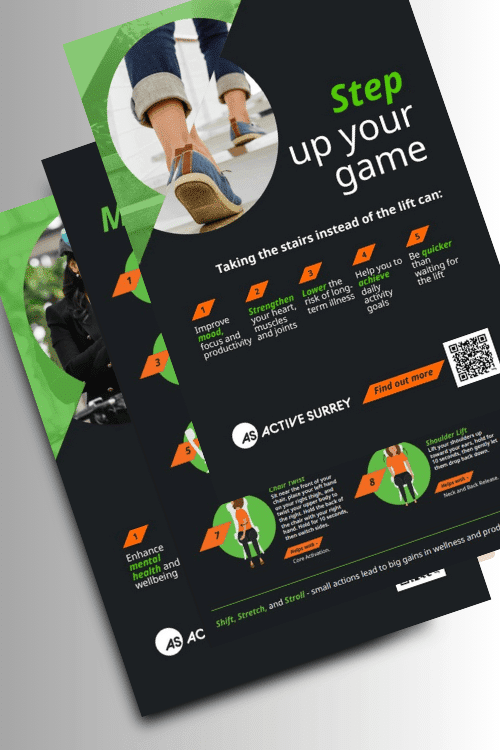
Moving regularly is a proven way to boost mood, build confidence and feel more energised. Active Surrey has released a new set of free workplace wellbeing posters designed to help employers promote movement and create healthier working environments.

Why is movement important?

Posters that encourage active choices

Active Surrey has created a toolkit of posters designed to gently nudge staff to choose healthier, more active options where they are able to:

  • Step Up Your Game – Choose the stairs instead of the lift – view here
  • Walk the Talk – Take your meetings on the move – view here
  • Make Your Commute Count – Walk or cycle to get to and from work – view here
  • Get Up, Stand Up – Break up long periods of sitting – view here

The posters work best if they are placed in high‑impact locations such as lifts, meeting rooms, and car parks, to encourage staff to consider taking up options for additional movement.

Movement posters for staff desks

The Active Surrey team also created two desk-friendly resources designed to be simple, accessible, and effective, helping workplaces build a culture where movement becomes a natural part of the working day.:

  • Desk-Based Stretches & Movements – a simple visual guide to stretches that ease tension and support better posture – view here
  • 6 Ways to Sit Less & Move More – quick, practical tips to help break up sitting time – from stretching at their desk to talking walking meetings – view here.

Use the posters around your workplace

Surrey businesses that would like their staff to benefit from increasing activity can easily:

Find out more about Active Surrey, and the Active Travel Grants that are currently available to help your staff travel to work in a more sustainable and healthy way.

Work experience pays off: Surrey businesses invited to try a new flexible approach

New flexible work experience options make it easier than ever for Surrey employers to offer placements to young people – with the benefits to businesses spelled out in recent research.

Gone are the days of the traditional five-day placement. New Government guidelines around work experience mean employers can now offer placements that fit around the realities of modern business – from half-day site visits and workplace safaris to hands-on projects and hybrid block placements spread across weeks rather than days.

The move comes as research from The Careers & Enterprise Company’s Employer Standards 2024/25 reveals that businesses engaging with work experience are 77% more likely to report tangible business benefits including a stronger talent pipeline. That figure rises to 90% among employers offering a broader range of experiences, including T-Levels and job shadowing.

A variety of formats means work experience now works for everyone

Surrey Careers Hub, which connects schools, colleges and employers across the county, is encouraging businesses to explore the new work experience offering to find a format that suits them.

Shorter site visits can welcome groups of students for guided tours, demonstrations and Q&A sessions with staff – giving young people a real window into a sector with minimal disruption to the working day. For businesses based on enterprise parks or industrial estates, workplace safaris offer a collaborative option. By partnering with two to four neighbouring employers to host students for 30 to 45 minutes each, businesses can share the load while giving students a richer, multi-business experience.

For employers wanting deeper engagement, block placements have been redesigned for flexibility. Students can attend on consecutive days, one day, of just a couple of hours a week over a month, or through a hybrid mix of in-person and virtual. Hands-on project briefs go further still. This involves setting students a real business challenge; a marketing campaign, a sustainability proposal, a new piece of website content – with students presenting their final work to the team and receiving professional feedback.

Employers see the benefits to their business

Ellie Smith, Social Value Consultant at Epsom-based law firm AtkinsRéalis, said: “The new modern work experience system has made it much easier for us to connect with young people in a meaningful and flexible way. Our virtual work experience programme works particularly well because it removes barriers around travel and scheduling, enabling students to take part and gain real insight into the world of work.  

“We’ve found that project‑based work experience and insight days are especially effective, as they allow students to work on real‑world challenges and develop tangible skills while gaining a clearer understanding of the careers available in our sector. It’s been a really successful model for us, and we’re seeing genuine curiosity, confidence, and capability grow in the young people who take part.” 

Cath Burnet, Head of Audit at professional services firm KPMG UK, said: “At KPMG, we’ve seen how these experiences broaden horizons and help young people connect their strengths to real opportunities. But this only works when businesses collaborate. By opening our doors wider, we can offer young people a clearer picture of what’s possible and, in doing so, strengthen the future workforce.”

Ian Browne, Early Careers Leader at Lloyds Banking Group, added: “In the world of hybrid working, the traditional five-day work experience is ever challenging to achieve. Our approach offers experiences of the workplace of different lengths and venues for maximum flexibility and scale.”

Surrey Careers Hub provides tailored support to help businesses design visits that work for them, including guidance on accessibility and safeguarding.

To find out how your business can get involved, email careers.hub@surreycc.gov.uk or read more about the modern work experience opportunities.

Glass artist offers ‘completely unique and innovative’ service thanks to Growth Fund grant

From stained glass restoration to replicating family portraits on glass, Jim Cockerill of HALTglass already offered something special from his studio in Sutton Green. Now, after receiving a grant from Surrey County Council’s Economic Growth Fund for new equipment, he’s able to provide unique services unavailable elsewhere in the UK.

HALTglass specialises in creating high-resolution images on glass using traditional stained glass materials, combined with modern techniques such as silk screen printing and sandblasting.

The grant has enabled Jim to purchase two key pieces of equipment: a much larger kiln and a sandblaster.
“The kiln means I can take on architectural-scale projects for clients, while the sandblaster opens up a whole new market in technique and image preparation,” Jim said.

“The exciting thing about this sandblaster is I can offer processing that isn’t available anywhere else in the UK, so it’s very specialist. I’m working within a niche that will definitely expand my business.”
HALTglass serves a diverse client base, from architects and artists looking to realise their work in glass, as well as restoration specialists and stained glass studios.

Future possibilities for HALTglass, thanks to the grant funding

“I work with artists, designers, photographers and architects,” Jim said. “This will allow me to facilitate much larger commissions, much more ambitious commissions, as well as offer them services in glass decoration that are completely unique and quite innovative.

“I’m currently developing a screenprintable sandblast resist. A product and service which is completely new to the market and offering my clients new possibilities in glass.”

Jim noted he wouldn’t have been able to purchase the equipment without the Council’s support. He reports that the grant has made his business more sustainable and enabled growth that ‘could never have happened without this funding’.

“I’ll soon be opening up my facilities in the form of experience days to cater for a broader market and allow anyone who has a passion for the arts to try this new technique.”

More about the Surrey Economic Growth Fund

To date almost £2 million has been awarded to dozens of recipients via the Surrey Economic Growth Fund. This funding has helped to unlock significant match funding and private investment, growing Surrey’s economy by £9 million.

Any Surrey business looking for funding or help to grow can receive fully-funded support from Business Surrey. Get in touch via our Contact us form.

Halt glass - Jim screenprints onto glass in his Surrey workshop

Active Travel Grant for employers – help your staff travel to work in a more sustainable and healthy way

Grants of up to £5,000 are available to help your staff travel to work more sustainably and healthily, and in turn help boost productivity. Applications close on 5th April.

Many people live close enough to walk or cycle to work, but without the right encouragement and support, they find it hard. Something as simple as improved lighting, or an internal comms focus on walking, cycling and public transport can make a big difference.

Supporting staff to travel to work by walking, cycling or using public transport more helps employees be more active. This in turn helps improve mental health, relieves stress, and boosts productivity. Additionally, the cost to businesses of road congestion in Surrey has been estimated at £550m per year – so doing what we can to reduce road congestion will bring benefits to us all.

As well as funding, support is available in the form of a helpful resource toolkit: Surrey’s Smarter Travel Toolkit. Download it today to get started on your journey.

Get inspired

According to the Sustrans Walking And Cycling Index, 50% of adults want to walk and cycle more, compared to just 15% of us who say we want to drive more frequently. Employers can help their staff travel better, feel better, and work better by applying for an Active Travel Grant from Active Surrey, and by following the practical steps in Surrey’s Smarter Travel Toolkit.

Surrey businesses are using their grant for improved lighting, electric pool bikes and charging points, lockers, active travel events, cycling accessories, and bike shelters and servicing sessions.

What are the benefits?

Commuting through active modes improves the physical and mental health of employees and can also enhance job performance. And healthier employees take fewer sick days, boosting productivity. It is estimated that poor mental health costs employers an estimated £45 billion each year.

Improving staff travel options can help widen your recruiting pool

Commuting makes up roughly 10–20% of an employer’s Scope 3 Greenhouse Gas Emissions. Encouraging sustainable travel can help support employers reach their corporate goals and ambitions.
Implementing an employer travel plan signals a strong commitment to sustainability and corporate social responsibility, enhancing the organisation’s reputation and appealing to environmentally conscious customers and employees.

Encouraging active commuting like walking or cycling, and use of public transport, can help alleviate car park capacity issues. 10 to 20 bicycles can typically be stored in the space required for one vehicle.

Healthier and happier employees: the UK Chief Medical Officer recommends adults should aim to be physically active every day. Walking or cycling to work or use of public transport can help employees reach this goal and improve their physical and mental health.

Reducing the need for car parking allows space to be reallocated to other uses, for example more attractive public realm or space for further development.

Travel plans can help to improve access to the workplace for all, especially for people with mobility issues, as a result of reduced traffic.

Wider community benefits: implementing a travel plan can have wider community benefits such as reduced local traffic congestion and improved air quality.

What can you do next?

Apply for an Active Travel Grant today, and download the Surrey’s Smarter Travel Toolkit. Got any questions? Contact Active Surrey on active.surrey@surreycc.gov.uk.

Need further support and advice? Get in touch with our team of experts via the Business Support Form.

Lesh: maternity brand borne out of sleepless nights looks ahead to a bright future

Kat Fellows launched Lesh, a leak-proof nursing bra brand, from her Epsom home in August 2024. Now, with match funding from Surrey County Council’s Economic Growth Fund, she’s scaling the business and plans to hire local mothers as her team grows.

Before becoming an entrepreneur, Kat worked as a director in beauty marketing. “I got pregnant during Covid, not knowing what to expect when I returned to work,” she said. “As time went on, it became clear this corporate life wouldn’t mesh with being a mother.”

She decided to start a business solving a problem she’d experienced firsthand as a breastfeeding mother.

“The second my son latched on, it was amazing – I had this incredible experience,” Kat said. “I loved breastfeeding, but the only thing I didn’t love was that I leaked constantly.”

She cycled through countless disposable and reusable breast pads, and said: “They would move around, and I’d still wake up soaked, lying in a puddle of milk. Sleep is sacred when you have young children. Plus, the disposable ones are so wasteful.”

When she searched for alternatives, nothing met her needs. “Most products had clearly not been live-tested on a mum with oversupply like myself,” she said. I thought, “If no one is doing it the right way, I’m going to do it.”

Live-testing early Lesh prototypes

Kat spent a year and a half developing and testing prototypes during her second breastfeeding journey. “I never had to buy a disposable pad,” she said. “It took that long until I had something I was comfortable launching.”

Since launching in August 2024, Lesh has gained momentum, and the Economic Growth Fund will help propel it further.

“This grant will allow me to drive brand awareness and grow the business to a place where I can pitch for additional funding to become an internationally recognised brand in the maternity space,” Kat said.

Looking ahead, Kat envisions building a team of local mothers. “The first hire I needed was for social media – I’ve been using an agency, but I’d like that work to go to a local mum. I want to employ mothers who need that extra income. Eventually, I want to convert the garage into an office and warehouse, with local mums supporting customer service, order fulfilment, packaging, and returns.”

Evidently, big plans lie ahead for this innovative Surrey business.

More about the Surrey Economic Growth Fund

To date almost £2 million has been awarded to dozens of recipients via the Surrey Economic Growth Fund. This funding has helped to unlock significant match funding and private investment, growing Surrey’s economy by £9 million.

Any Surrey business looking for funding or help to grow can receive fully-funded support from Business Surrey. Get in touch via our Contact us form.

Emilia Hunt: high street dream becomes reality thanks to Growth Fund

Opening a shop was a long-held dream of maker and designer Emilia Hunt, and thanks to help from the Economic Growth Fund, that dream is now a reality.

She opened her self-titled shop on 17 Bell Street, Reigate, in September, selling handmade and bespoke items at accessible price points. As well as her own products, which include homewares, gifts and stationery, she also sells carefully selected items from other makers.

“I know hundreds of makers,” Emilia said. “And I’ve got all the good ones in my shop.”

British made products are the focus of the shop, with three quarters of the products made in the South East.

“Everything in the shop is UK made. I am a real stickler for making sure everything is actually made in the UK. Everything in the shop I have chosen.”

Emilia started her business 10 years ago after taking medical retirement due to cystic fibrosis, and since then has been building a homewares brand which is now stocked in places like Squires Garden Centres.

The High Street dream

It was when she had a small space above an antiques shop that Emilia realised a high-street stop could work.

“You couldn’t see my stuff from the front window,” she said. “Every single person came up and said I didn’t know you were here. But it was so well received. I was talking to my mum and said this could work, people really like it. It needs to be somewhere where people can see it.”

She then found out a shop vacancy was coming up on Reigate high street and made an enquiry with the owners.

“I found out it was very expensive,” said Emilia. “There were two offers higher than mine, but I shared with them my vision and they accepted mine. They’ve given me a chance.”

How the funding has helped

She said she couldn’t have done it without the Economic Growth Fund, which has gone towards helping the shop launch, as well as admin costs and things like a music license to play music on the premises.

On her vision for the shop, Emilia said: “I want it to have a welcoming feel and be accessible for people. I wanted things to be £3.50 and £10, I want people to know handmade doesn’t necessarily mean expensive. It can be done, it doesn’t cost the earth.

“I want to have conversations. I always try to be available for people to ask questions. Obviously, it’s about quality products, but if you make the customer experience the best it can be, that customer is going to remember that and talk about that when they get home, I want people to have the best experience.”

On her advice for budding start ups or established business owners who want to take a leap, Emilia said: “Anyone can do what they really want to do; do some drawing, make something, have a bit more faith in yourself, apply for the funding, see what you can get going. If you have got an idea, just believe in yourself.”

More about the Surrey Economic Growth Fund

Surrey County Council launched the Economic Growth Fund in April 2025 with the aim to support ideas that will accelerate growth, boost innovation and create new employment opportunities.

Approximately £2 million was distributed when the first round of grants was announced in September 2025.

With a further £1 million awarded in round two, the total invested locally in 2025 now stands at more than £3 million.

The Economic Growth Fund is one of several ways the council supports businesses and the regional Surrey economy.

To register for fully-funded support to start and grow a business get in touch via our Business Support Form.

Dorking Distilleries set for success thanks to the Surrey Economic Growth Fund

Dorking Distillery is a new custom-made distillery at Denbies Wine Estate, conceived by five co-founders who purchased the artisan drinks brand the Gin Kitchen. The grant from the Economic Growth Fund has been used to help repurpose and convert two fabricated sea containers to create their new distillery.

Co-founder Serena Billinghurst said: “ We are a premium spirits producer using the highest quality ingredients. We have been lucky to work with local artist Charlotte Godfrey to redesign the Gin Kitchen collection range, using the same much loved ceramic bottles, with new artwork which we are excited to share.

“We have built our distillery at Denbies, and are starting by selling the Gin Kitchen range, but also plan to develop a zero-alcohol drink and other spirits over time as well. We will also be offering a refill service, so instead of having to buy another bottle you can visit and refill straight from the still, or receive a refill pouch out in the post.”

Exciting plans for the future

As well as growing the product range, the team at Dorking Distillery has also set its sights on events.

We would like to host tasting events from the distillery and start organising larger music events in the future,” said Serena. “That is a key part of where we see our growth. The events are an exciting opportunity for us to create more jobs in the county and put Surrey on the map as the place to go for artisan gin tasting.”

The grant from the Economic Growth Fund has helped get the project over the line and enabled the launch.

“This grant has been the life changing boost that we needed to get us over the line with creating the distillery,” Serena said.

“This project has been like an onion, with many layers, it has been a challenging but also an amazing experience and we’re excited to be open!”

What is the Surrey Economic Growth Fund?

Surrey County Council launched the Economic Growth Fund in April 2025 with a focus on supporting ideas to accelerate growth, boost innovation and create new employment opportunities.

About £2 million was distributed when the first round of grants was announced in September 2025.

With a further £1 million awarded in round two, the total invested locally in 2025 now stands at more than £3 million.

The Economic Growth Fund is one of several ways the council supports businesses and a growing Surrey economy.

To register for fully-funded support to start and grow a business get in touch via our Business Support Form.

Dorking Distilleries set for success thanks to help from the Surrey Economic Growth Fund

Unlock hidden talent for hard-to-fill job roles with Connect to Work

Finding the right people for hard-to-fill roles is one of the biggest challenges facing employers today. With around 728,000 vacancies across the UK, many businesses are struggling to fill skills gaps. But what if there was a ready pool of motivated, loyal candidates – backed by expert support to ensure they succeed in your business?

Connect to Work is a new supported employment programme funded by UK government, and delivered by Surrey County Council. It connects employers with those who want to work but face barriers to employment. The scheme includes people living with disabilities, health conditions, and those experiencing other significant challenges in accessing the job market.

Compelling business case

Research by Mencap found that workers with learning disabilities often have no whole-day absences, far fewer late arrivals and significantly higher job loyalty than the UK average.

And according to a broad review by CBM UK, inclusive employment – correctly supported – can lead to equal or greater productivity, lower absenteeism, better attendance and stronger safety records. The review also found workplace accommodations for disabled staff often benefit the wider workforce (e.g. flexible work, better wellbeing support), improving overall staff retention and company resilience.

All this leads to lower staff turnover, which reduces costs associated with recruitment, onboarding and training. And sectors that struggle to recruit, such as retail, hospitality, social care and logistics, often match well to the skills and flexibility offered by disabled or learning-disabled candidates.

Tap into talent

By partnering with Connect to Work, you’ll also tap into a substantial, under-utilised talent pool. Research shows that 86% of people with learning disabilities who aren’t working want a job. These candidates are particularly well-suited to roles involving routine tasks, warehousing, retail, and basic admin – exactly the positions many employers struggle to fill.

Tangible business benefits

And the benefits extend beyond just filling job roles. Businesses that embrace inclusive hiring report improved workplace morale, better team cohesion and a more empathetic, supportive culture. Your reputation strengthens too, building community trust that’s invaluable for customer-facing businesses. Inclusive hiring also enhances your employer brand by boosting your evidence of social value, and can help your business secure contracts where diversity and social impact matter.

How to get involved

Connect to Work is completely free to employers of any size, matching Connect to Work’s supported candidates to your vacancies at minimum wage or above.

Your dedicated Employment Specialist will help with job matching, supporting the application process, and providing ongoing workplace support for as long as needed – ensuring success for everyone involved.

If you’re ready to build a stronger workforce, get in touch at STEPSurrey@surreycc.gov.uk to discuss how Connect to Work can benefit your business.